

To calibrate or not to calibrate? – this is the question

10 Oct 2022

Author

Wacław Adamczyk

Wacław Adamczyk

Waclaw Adamczyk is the head of the Pain Research Laboratory, author of numerous publications, and director of the OPUS-19 project from NCN “Where is your pain? Classically conditioned spatial dimension of pain in humans.” Currently in a post-doc position at Cincinnati Children’s Hospital Medical Center (OH, USA) in the team of Prof. Robert Coghill.

Enjoy your reading – a freshly published article from our lab in collaboration with colleagues from Lübeck (Germany) and Cincinnati (USA) available in Open Access format!

If you’ve conducted or are planning to conduct a pain experiment involving humans, there’s a good chance you’ve faced a similar dilemma, and you probably know how time-consuming it is to make the right decision. If you haven’t read our recent paper yet, here’s a summary of it: Imagine that you want to induce pain during your experiment. You can do this in two ways:

  • i) everyone receives the same dose/intensity of stimulus

or

  • ii) you calibrate the intensity of the stimulus so that everyone feels pain at the same intensity.

However, which approach is better? And is either one better at all? In this article, we outline the advantages and disadvantages of each approach and conduct a simulation study using data from our lab.
Autor wpisu

Wacław Adamczyk

Wacław Adamczyk

Waclaw Adamczyk is the head of the Pain Research Laboratory, author of numerous publications, and director of the OPUS-19 project from NCN “Where is your pain? Classically conditioned spatial dimension of pain in humans.” Currently in a post-doc position at Cincinnati Children’s Hospital Medical Center (OH, USA) in the team of Prof. Robert Coghill.

Related

PAR Project in The Journal of Pain!

PAR Project in The Journal of Pain!

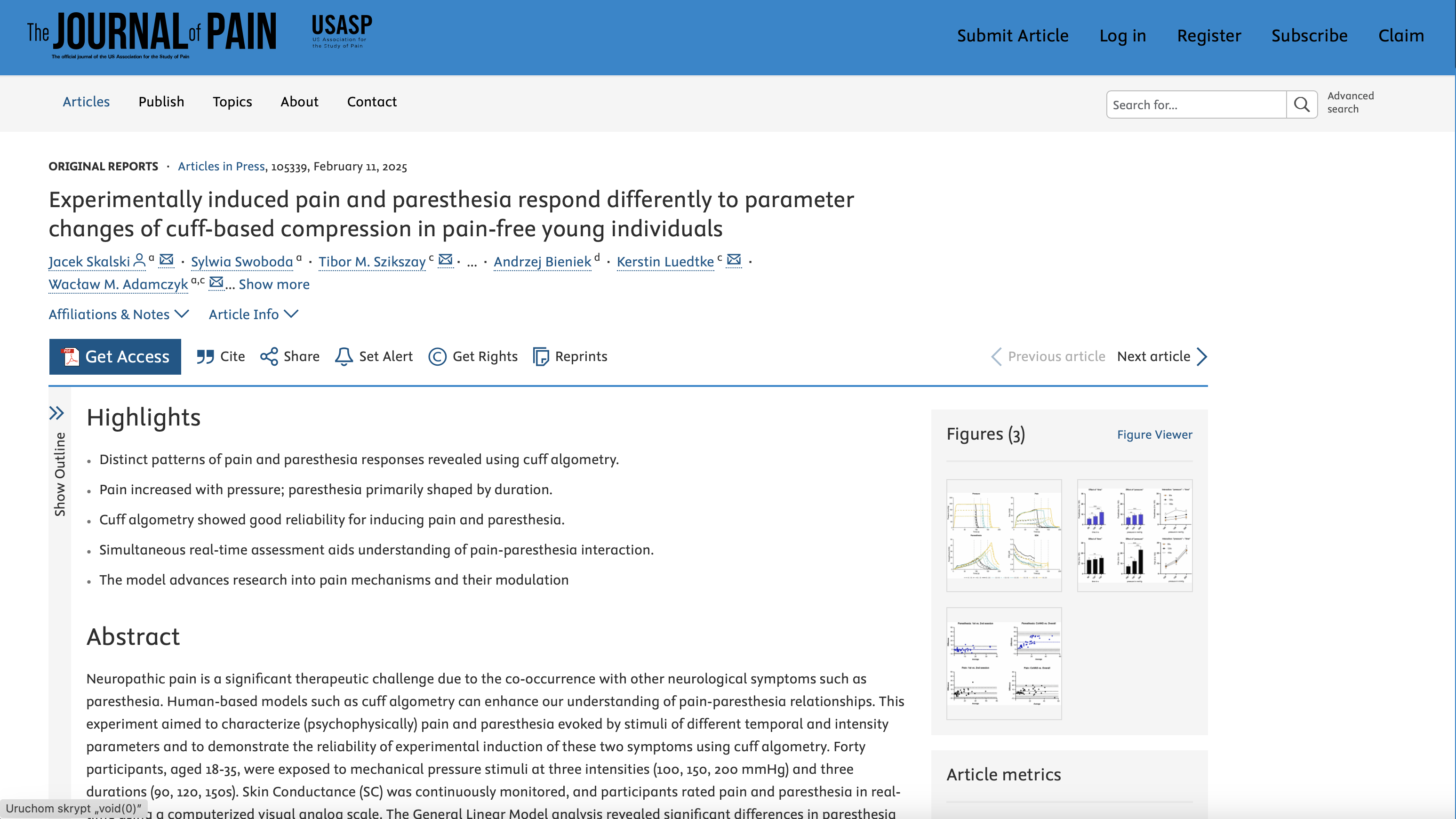
We are happy to announce that our team's project has just been published in the renowned journal The Journal of Pain! Experimentally induced pain and paresthesia respond differently to parameter changes of cuff-based compression in pain-free young individuals Aim of...

read more
IASP World Congress on Pain 2022 Toronto, Kanada

IASP World Congress on Pain 2022 Toronto, Kanada

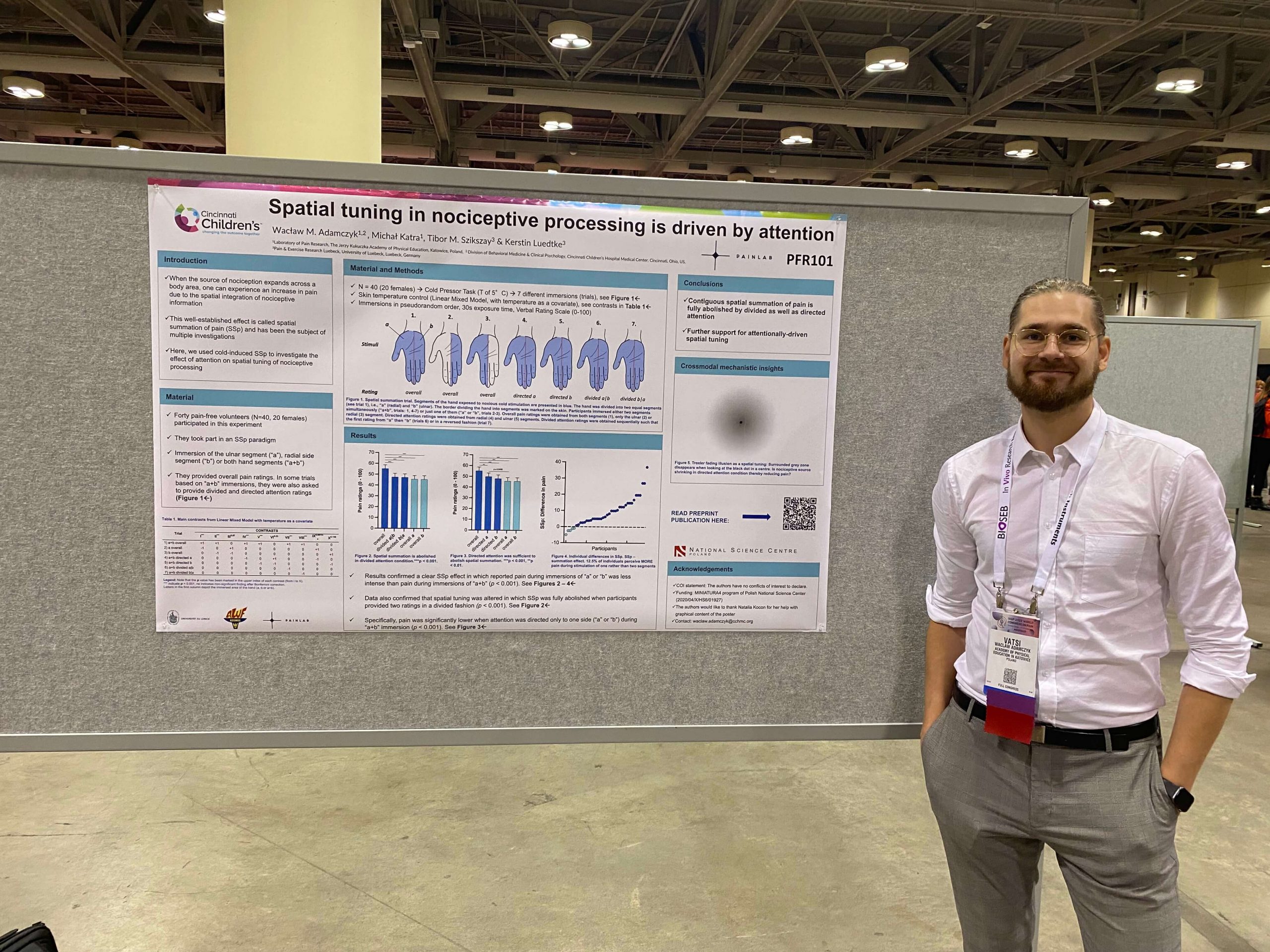
On 19-23.09.2022, members of our team consisting of Waclaw M. Adamczyk, Aleksandra Budzisz, Tibor Szikszay and Jacek Skalski, participated in the IASP 2022 World Congress on Pain in Toronto - the most important scientific conference on pain science related issues,...

read more
COLOR-19

COLOR-19

Another success for our team! We are entering the New Year with a bang! Our team's study has been accepted for publication in PAIN® and will be published soon! The main aim of this study was to investigate whether classical conditioning can be involved in ‘learning’...

read more
PAR Project in The Journal of Pain!

PAR Project in The Journal of Pain!

We are happy to announce that our team's project has just been published in the renowned journal The Journal of Pain! Experimentally induced pain and paresthesia respond differently to parameter changes of cuff-based compression in pain-free young individuals Aim of...

read more
IASP World Congress on Pain 2022 Toronto, Kanada

IASP World Congress on Pain 2022 Toronto, Kanada

On 19-23.09.2022, members of our team consisting of Waclaw M. Adamczyk, Aleksandra Budzisz, Tibor Szikszay and Jacek Skalski, participated in the IASP 2022 World Congress on Pain in Toronto - the most important scientific conference on pain science related issues,...

read more
COLOR-19

COLOR-19

Another success for our team! We are entering the New Year with a bang! Our team's study has been accepted for publication in PAIN® and will be published soon! The main aim of this study was to investigate whether classical conditioning can be involved in ‘learning’...

read more