
PAR Project in The Journal of Pain!

17 Feb 2025

Author

Jacek Skalski

Jacek Skalski

Physiotherapist since 2011. Doctoral student at the Doctoral School of Academy of Physical Education in Katowice since 2019. Head of the PRELUDIUM 19 project from the National Science Center. He is particularly interested in the effects of placebo and nocebo effects on pain perception and the possible generalization (transfer) of these o effects to other symptoms. In addition, he is interested in chronic pain, the effects of manual therapy on pain, EBP (evidence-based practice) in physiotherapy, and neurorehabilitation.

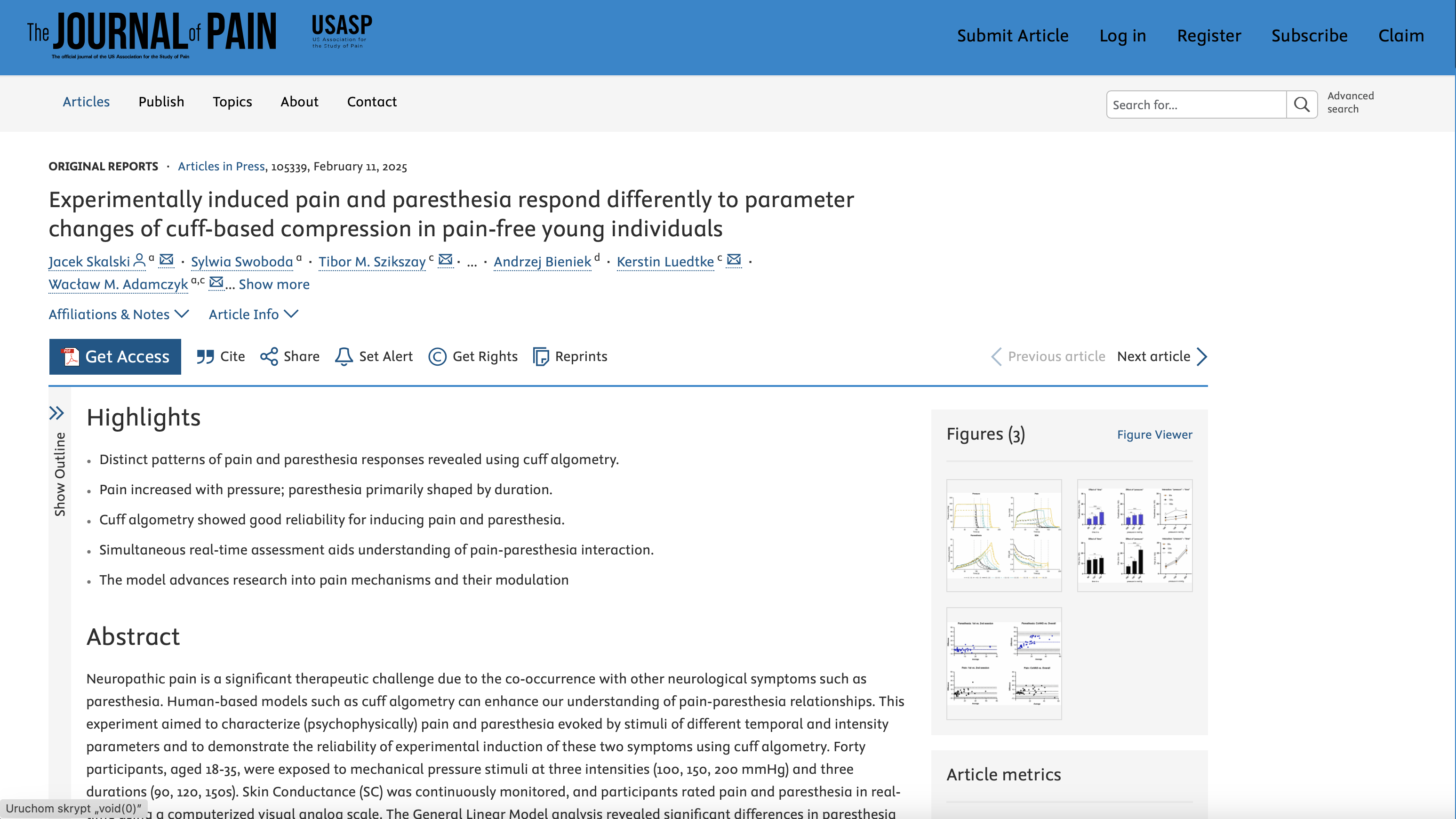
We are happy to announce that our team’s project has just been published in the renowned journal The Journal of Pain!

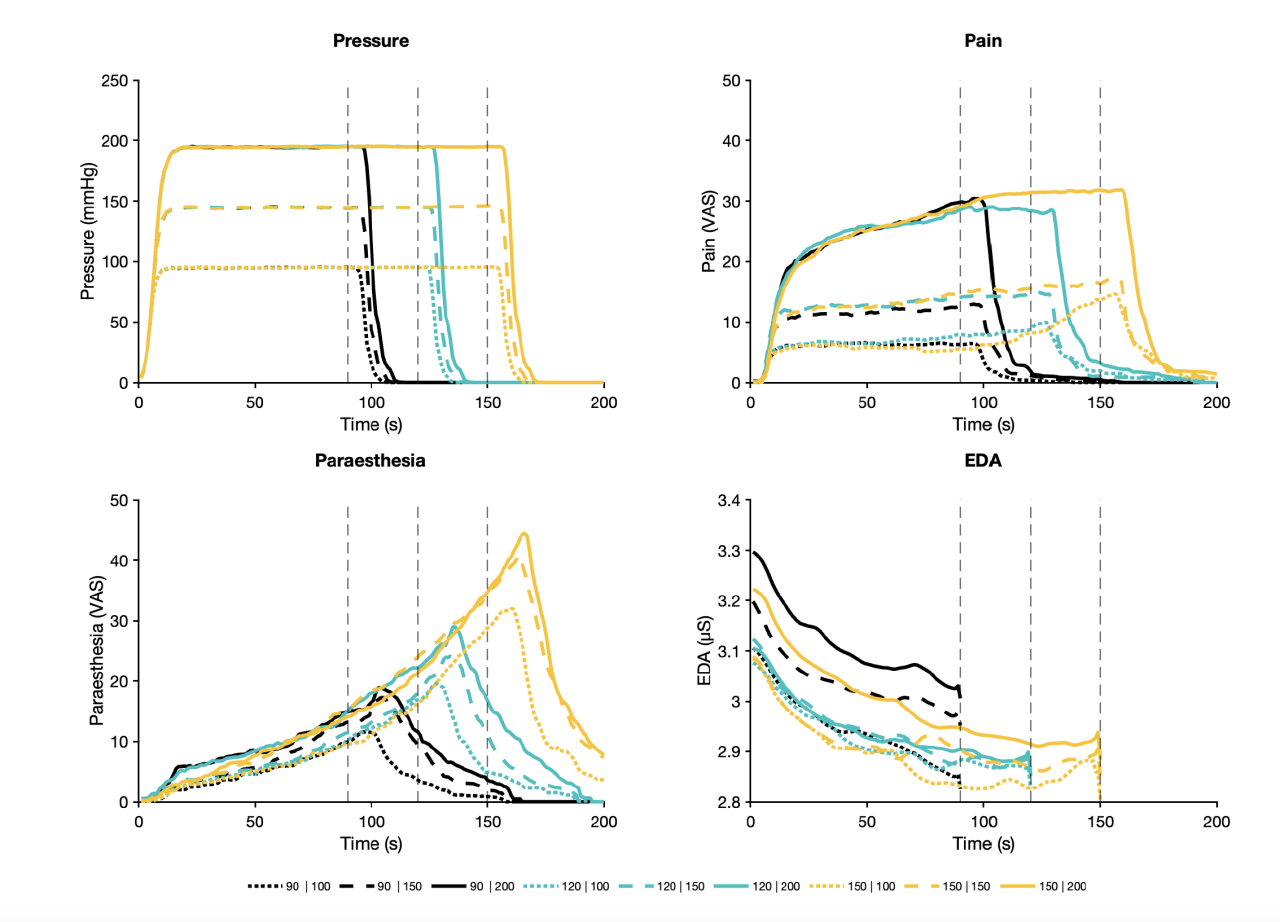
Experimentally induced pain and paresthesia respond differently to parameter changes of cuff-based compression in pain-free young individuals

Aim of the study
The main aim of our experiment was to:
1.To characterise (psychophysically) pain and paresthesia induced by stimuli of different time parameters and intensities.
2.To demonstrate the reliability of experimental evocation of these two symptoms using cuff allometry.
Why this is important.
Neuropathic pain represents a significant therapeutic challenge, often co-occurring with other neurological symptoms such as paresthesia. Our study, using a human-based model (cuff algometry), aims to further our understanding of the relationship between pain and paresthesia.
A better understanding of these mechanisms may in the future contribute to the development of more effective treatments for neuropathic pain, improving the quality of life for many patients.
Follow our next posts to learn more about the results of this fascinating study!

https://www.jpain.org/article/S1526-5900(25)00566-8/fulltextrostral anterior cingulate cortex

The study was published as part of the PRELUDIUM19 project (2020/37/B/HS6/04210)
Autor wpisu

Jacek Skalski

Jacek Skalski

Physiotherapist since 2011. Doctoral student at the Doctoral School of Academy of Physical Education in Katowice since 2019. Head of the PRELUDIUM 19 project from the National Science Center. He is particularly interested in the effects of placebo and nocebo effects on pain perception and the possible generalization (transfer) of these o effects to other symptoms. In addition, he is interested in chronic pain, the effects of manual therapy on pain, EBP (evidence-based practice) in physiotherapy, and neurorehabilitation.

Related

IASP World Congress on Pain 2022 Toronto, Kanada

IASP World Congress on Pain 2022 Toronto, Kanada

On 19-23.09.2022, members of our team consisting of Waclaw M. Adamczyk, Aleksandra Budzisz, Tibor Szikszay and Jacek Skalski, participated in the IASP 2022 World Congress on Pain in Toronto - the most important scientific conference on pain science related issues,...

read more
COLOR-19

COLOR-19

Another success for our team! We are entering the New Year with a bang! Our team's study has been accepted for publication in PAIN® and will be published soon! The main aim of this study was to investigate whether classical conditioning can be involved in ‘learning’...

read more
To calibrate or not to calibrate? – this is the question

To calibrate or not to calibrate? – this is the question

Enjoy your reading - a freshly published article from our lab in collaboration with colleagues from Lübeck (Germany) and Cincinnati (USA) available in Open Access format! If you've conducted or are planning to conduct a pain experiment involving humans, there's a good...

read more
IASP World Congress on Pain 2022 Toronto, Kanada

IASP World Congress on Pain 2022 Toronto, Kanada

On 19-23.09.2022, members of our team consisting of Waclaw M. Adamczyk, Aleksandra Budzisz, Tibor Szikszay and Jacek Skalski, participated in the IASP 2022 World Congress on Pain in Toronto - the most important scientific conference on pain science related issues,...

read more
COLOR-19

COLOR-19

Another success for our team! We are entering the New Year with a bang! Our team's study has been accepted for publication in PAIN® and will be published soon! The main aim of this study was to investigate whether classical conditioning can be involved in ‘learning’...

read more
To calibrate or not to calibrate? – this is the question

To calibrate or not to calibrate? – this is the question

Enjoy your reading - a freshly published article from our lab in collaboration with colleagues from Lübeck (Germany) and Cincinnati (USA) available in Open Access format! If you've conducted or are planning to conduct a pain experiment involving humans, there's a good...

read more